How Does Hindu Cremation in Dubai Work?
Hindu cremation in Dubai takes place at the New Sonapur Hindu Cremation Ground in Jebel Ali, a crematorium run by a Hindu community committee under Dubai Municipality. Before a slot is confirmed, you need the death certificate, an embassy no objection letter, police clearance and a Dubai Municipality cremation permit, which is now free. In a straightforward hospital case, the cremation usually happens two to four days after death, and the family can take the ashes home for asthi visarjan.
If you are reading this, someone in your family has probably just died in Dubai, and the family wants the antyesti done properly. That is possible here. Dubai has had a Hindu cremation ground for decades, pandits are available for both North and South Indian traditions, and the ashes can travel home with you for asthi visarjan.
What families usually don’t know is the order things have to happen in. This guide covers that, along with what the day itself looks like and what it costs in 2026.
Where does the cremation take place?
There is one crematorium in Dubai. Its official name is the New Sonapur Hindu Cremation Ground, even though it sits in Jebel Ali and not in Sonapur, which confuses a lot of people searching for it. It is run by a Hindu community committee under the supervision of Dubai Municipality.
Despite the name, it is not only for Hindus. Sikh, Jain, Buddhist, Christian and non-religious families use it too. Muslims cannot be cremated in the UAE.
If the death happened in another emirate, Sharjah and Al Ain also have crematoriums. Moving a body between emirates for cremation needs extra police permission, so tell us early if you would prefer Dubai.
Who can be cremated in Dubai?
Non-Muslims only.
The religion recorded on official documents is what the authorities go by.
Residents and visitors.
People often assume a visit visa rules out cremation. It doesn’t. Visitors can be cremated here or repatriated. What they cannot have is a local burial, which requires a UAE residence visa.
Not young children.
Children under three cannot be cremated in the UAE. They are buried here or repatriated. If this is your situation, please call us, and we will go through the options with you quietly.
Which documents are needed?
The crematorium won’t confirm a slot until it has the following:
- The death certificate (in Dubai this now comes through the DHA’s Jabr system, explained below)
- The death notification from the hospital, or the police report if the death happened elsewhere
- Copies of the passport, visa and Emirates ID of the person who died
- A no objection letter from the embassy or consulate, for example the Consulate General of India
- Police clearance
- The cremation permit from Dubai Municipality
- A no objection letter from the next of kin, and a copy of that person’s passport, visa and Emirates ID
- A marriage certificate, if the person was married
Two of these got easier recently. Since December 2025, Dubai’s Jabr system gives every bereaved family a government service officer who handles the death certificate and the government side of the paperwork. And since February 2026, Dubai Municipality no longer charges for the cremation permit for non-Muslims.
What happens on the day
Most families have never been to a cremation outside India, so here is roughly what to expect.
We bring your loved one from the mortuary to the cremation ground. If the family wants the ritual bath and dressing, we arrange for it to be done beforehand. Some families do it themselves and others prefer us to.
The family gathers in the prayer area with the pandit. The rites follow your tradition. For most families that means mantras, offerings of ghee, rice, tulsi and flowers, and a final circling of the body by the son or the closest male relative before the mukhagni. Families from the South often bring their own customs, and the pandit will follow the family’s lead.
After that the cremation itself takes place in a modern chamber, not an open pyre. Many families find this hard at first, so it helps to know in advance. The rites before it are yours, done in full.
The ashes are usually ready for collection the next day.
Bring white clothing if your family observes that custom. Bring any items you want placed with your loved one, and someone who can make decisions on the family’s behalf. You don’t need to bring ritual items unless you want specific ones. We can arrange the puja samagri.
Choosing a pandit and a muhurat
Tell us which tradition the family follows, such as Tamil, Telugu, Malayalam, Gujarati, Punjabi, Bengali or Marathi. We’ll ask a pandit from that tradition. If the family wants the cremation timed to an auspicious hour, give us the time window as soon as you can. Slots at Jebel Ali are limited, so we can’t always guarantee an exact time, but we’ll try to work around it.
Taking the ashes home
For most Hindu families, the cremation in Dubai isn’t the last step. The asthi still need to go to the Ganga at Haridwar or Varanasi, to Rameswaram, or to a river near home.
Ashes are far simpler to move than a body. Practical points:
- Carry the cremation certificate, the death certificate and a copy of the cancelled passport with you. Airport and airline staff can ask for them.
- Use a sealed but scannable urn. Metal and stone urns often can’t be X-rayed, which can mean the urn has to be opened at security.
- Check your airline before you fly. Emirates generally accepts ashes as checked or cabin baggage if they are properly packed. Etihad does not allow ashes in the cabin at all. On every Etihad flight they must go in checked baggage or as cargo.
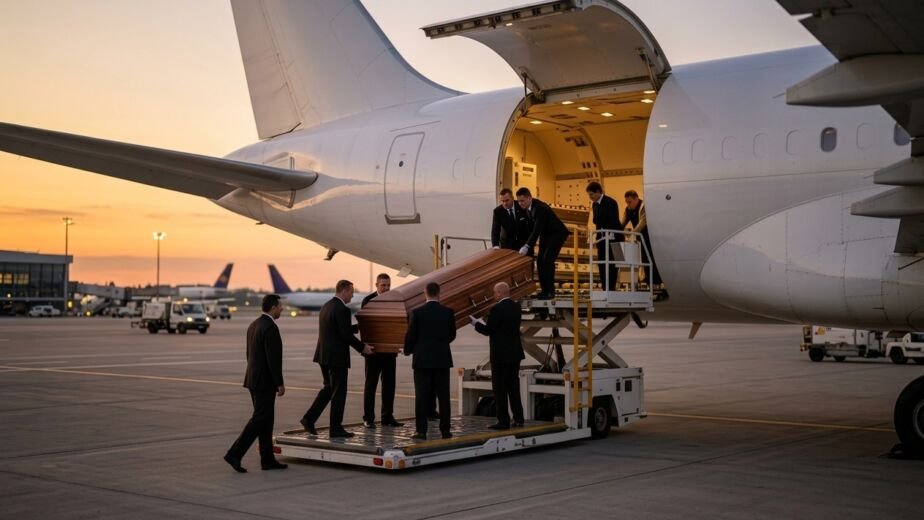
If nobody from the family is travelling soon, the ashes can be sent as cargo. Our ash and urn repatriation service handles this.
How much does it cost?
In 2024, Khaleej Times reported that a cremation at Jebel Ali cost about AED 3,500, including the Dubai Municipality fee. Dubai abolished that Municipality fee in February 2026, so the fixed cost at the crematorium should now be lower than it was. We confirm the current figure when we book.
On top of that, families usually pay for transport from the mortuary, the pandit and ritual items, the urn, any translations, and the funeral company’s coordination. If the ashes are shipped rather than carried, add the cargo cost.
We quote the full amount in writing for your case before anything is booked. If the person who died was employed in the UAE, check with the employer first. UAE labour law makes the employer responsible for preparing and transporting a worker’s body if the family requests repatriation. Many employers also help with local cremation costs when asked.
Frequently asked questions
Can women attend the cremation?
Yes. Who attends and who performs which rite is the family's decision. The crematorium does not restrict it.
Can we do the 13th-day rites in Dubai?
Yes. Several temples and community halls in Dubai host shraddha and terahvin ceremonies, and we can put you in touch with a pandit for them.
What if the body is still with the police?
If the death happened outside a hospital, the police and the public prosecutor have to release the body before anything else can happen. That can take a few days. We stay in contact with the case and book the cremation as soon as the release comes through.
Can the ashes be scattered in the UAE?
Almost every family we help takes the ashes home. Rules on scattering inside the UAE aren't clearly published, so we would rather check your specific plan than guess. If you need to keep the urn for a while before travelling, we can hold it safely for you.
Tell Us What Has Happened. We Will Guide You.
During a difficult moment, your family should not have to learn unfamiliar procedures while trying to grieve.
Global Nest Worldwide provides one point of coordination for funeral, burial, cremation and repatriation arrangements in Dubai and across the UAE.