How Much Does an Air Ambulance from Dubai to India Cost?
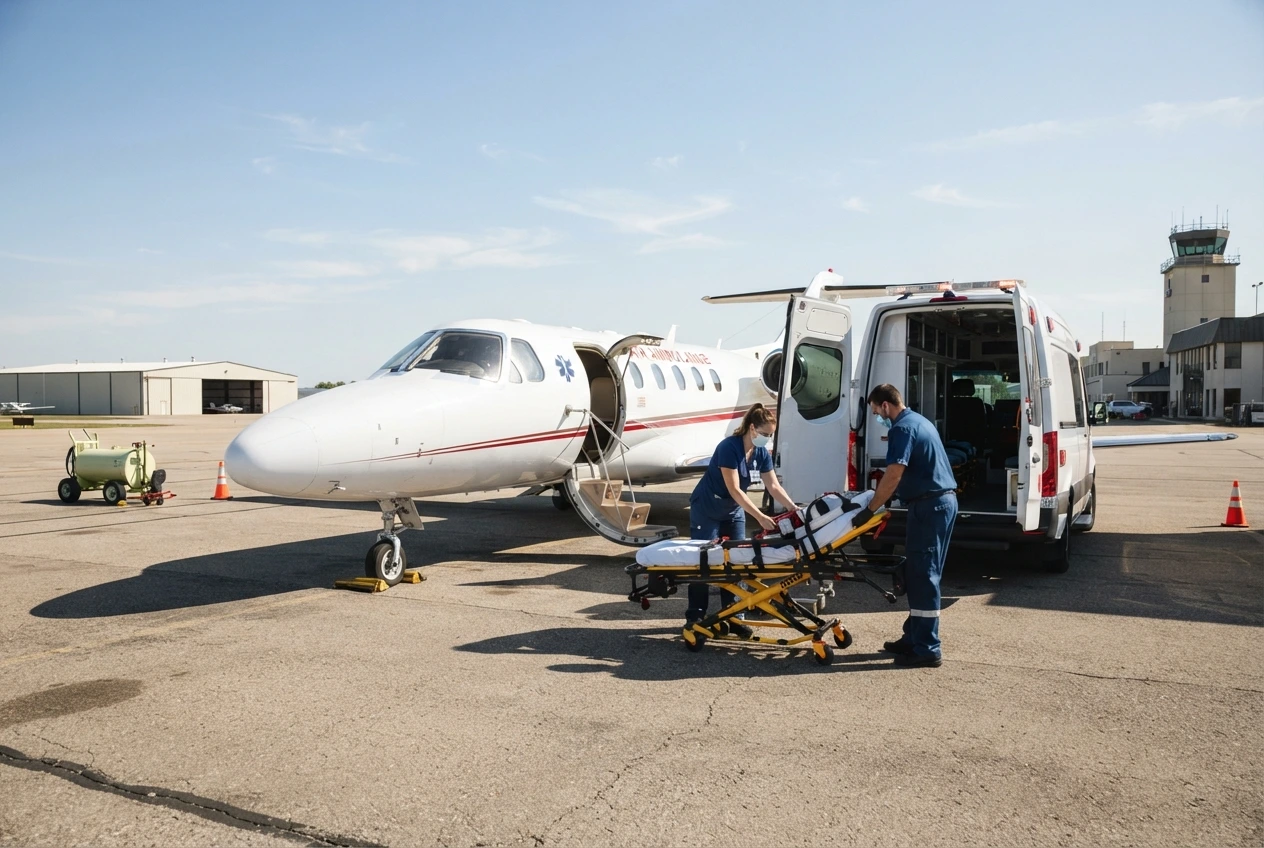
There is no fixed air ambulance Dubai to India cost. The price depends on the aircraft, the medical crew and equipment, the distance to the Indian city, ground ambulances at both ends, and how quickly you need to fly. A dedicated air ambulance is the most expensive option; a stretcher on a scheduled flight, or a seat with a medical escort, usually costs far less if the treating doctor agrees the patient can travel that way. Always ask for an itemised written quote.
When a parent or spouse is in hospital in Dubai and the family wants them treated at home in Kochi, Hyderabad or Delhi, the first question is almost always about money. It’s a fair question, and you deserve a straight answer about what you are paying for.
This guide explains what goes into a quote, the three ways a patient can travel, and the checks that have to happen before any aircraft leaves. We coordinate air ambulance assistance from the UAE, working with licensed aviation and medical providers who deliver the clinical care.
What makes up the air ambulance Dubai to India cost
Every quote is built from the same pieces. Knowing them helps you compare two quotes properly.
Cost factor | Why it changes the price |
Aircraft type | A small jet suits most Indian cities; a larger aircraft is needed for more equipment, more crew or a family member travelling along |
Distance and destination | Mumbai or Kochi is a shorter flight than Delhi or Kolkata; smaller airports may limit which aircraft can land |
Medical crew | A doctor and nurse cost more than a paramedic alone; an intensivist or specialist team (for example for a child or a ventilated patient) costs more again |
Equipment and oxygen | Ventilator, infusion pumps, incubator and the amount of oxygen needed for the flight |
Ground ambulances | Bedside in Dubai to the aircraft, and aircraft to the receiving hospital in India |
Timing | A flight within hours costs more than one planned a few days ahead; the aircraft’s positioning and return leg are often priced in |
Airport and handling fees | Landing, parking and handling charges in both countries |
Companion | Whether a relative can fly on board, and if there is room |
Is there a published price?
Very little reliable public data exists, and online “starting from” prices rarely include everything. One reference point: in March 2023 Gulf News reported a paediatric intensive care transfer from Abu Dhabi to New Delhi that cost Dh230,000. The provider told the paper that an air ambulance or charter generally ran between Dh200,000 and Dh250,000, and transport on a passenger flight between Dh40,000 and Dh50,000, depending on location and the patient’s condition. Treat these as one provider’s figures from 2023, not a current price list. Your own quote can differ a great deal.
Three ways to fly a patient home, and how cost compares
Not every patient needs a private aircraft. The treating doctor decides what is clinically safe; cost comes second to that.
Option | Who it usually suits | Relative cost |
Dedicated air ambulance | Unstable or critically ill patients, ventilated patients, anyone the doctor says cannot fly on a passenger aircraft | Highest |
Stretcher on a scheduled flight | Stable patients who must lie flat, travelling with a medical escort | Middle; seats are blocked for the stretcher and an escort travels |
Seat with a medical escort | Stable patients who can sit upright but need a nurse or doctor watching them | Lowest of the medical options |
A stretcher on a commercial flight needs the airline’s medical approval and is subject to space on the route, so it is not always available on the date you want. A seat with a medical escort suits patients who are recovering well but should not travel alone.
Clearance comes before booking
A quote means little until the patient is cleared to fly. Three approvals usually have to line up.
1. Fit to fly from the treating doctor
The hospital doctor in Dubai assesses whether the patient can travel and in what way. For a scheduled flight, airlines ask for their own form. Emirates asks for a Medical Information Form (MEDIF) when a passenger needs a stretcher, oxygen or a medical escort: part 1 is completed by or for the passenger, part 2 by the treating physician, and it should be submitted at least 48 hours before the flight. flydubai asks for medical clearance or a fit-to-fly certificate in similar situations, signed and stamped, in English or Arabic, and the airline still has the final say. For a dedicated air ambulance, the provider’s own medical team reviews the case instead.
2. A bed at the receiving hospital in India
The flight should not be booked until a named hospital in India has accepted the patient, ideally with a named consultant, and confirmed a bed of the right type (ICU, HDU or ward). Ask the receiving hospital for written acceptance. Without it, a patient can land with nowhere ready to go.
3. Insurer pre-approval, if insurance is paying
If a travel or health policy is covering the transfer, the insurer or its assistance company usually needs to approve it in advance, and may choose the provider or the mode of transport. Check before you pay a deposit; many policies won’t reimburse a transfer they didn’t approve. If an employer is involved, ask HR early, as some company policies include medical repatriation.
Arriving in India
A living patient arriving in India travels as a passenger. No special health import permit is needed for the patient, unlike the eCARe clearance required when a deceased person is repatriated. The patient needs their passport, and a foreign national needs a valid Indian visa or e-visa. For a dedicated air ambulance, the operator arranges India’s flight clearance; India’s aviation rules relax the usual advance notice for ambulance flights but still ask for the patient’s and doctor’s details.
On landing, a ground ambulance takes the patient to the receiving hospital and the medical crew hands over to the team there with the medical summary.
Booking, step by step
- Ask the treating doctor in Dubai for an up-to-date medical report and their view on how the patient can fly.
- Choose the receiving hospital in India and get written acceptance.
- Contact the insurer or employer, if either may be paying, and get their approval in writing.
- Request itemised quotes for the option the doctor has recommended.
- Confirm the flight date, crew and ground ambulances, and complete the airline or provider medical forms.
- Settle the hospital bill in Dubai and collect the discharge summary, scans and medication list.
- Fly, with handover at the Indian hospital.
If the patient is still in hospital here, our hospital assistance in Dubai can help you gather reports and talk to the treating team.
Quote checklist
Before you agree to anything, make sure the written quote answers these.
- Which aircraft, and is it fitted as an air ambulance?
- Who is the medical crew (doctor, nurse, paramedic) and what are their qualifications?
- Which equipment is on board, and how much oxygen?
- Are ground ambulances at both ends included?
- Are airport, landing and handling fees included?
- Can a family member fly along, and is there a charge?
- What happens, and what do you pay, if the flight is delayed or the doctor says the patient can’t fly on the day?
- What deposit is required, and what is refundable?
- Will the provider deal with the insurer directly?
Frequently asked questions
How much does an air ambulance from Dubai to India cost?
It varies with the aircraft, crew, equipment, destination and timing. A 2023 Gulf News report quoted one provider at Dh200,000 to Dh250,000 for an air ambulance or charter, but you should rely only on an itemised quote for your case.
Is a commercial stretcher cheaper than an air ambulance?
Usually much cheaper. It is only suitable if the treating doctor and the airline both agree the patient is stable enough for a passenger flight.
Will insurance pay for an air ambulance?
Some travel and health policies cover medical repatriation, often only when the insurer approves it beforehand and finds it medically necessary. Read the policy and ask the insurer before booking.
How quickly can a patient be flown to India?
An air ambulance can sometimes be arranged within a day once the patient is cleared, the hospital in India has accepted them and payment is agreed. A commercial stretcher depends on airline approval and seat availability.
Do we need a permit for the patient to enter India?
A living patient enters India as a normal passenger with a passport and, if foreign, a visa. The air ambulance operator handles the flight clearance.
Tell Us What Has Happened. We Will Guide You.
During a difficult moment, your family should not have to learn unfamiliar procedures while trying to grieve.
Global Nest Worldwide provides one point of coordination for funeral, burial, cremation and repatriation arrangements in Dubai and across the UAE.